5 Breathing Exercises for COPD That Can Help You Breathe Easier at Home
If you live with chronic obstructive pulmonary disease (COPD), you know how quickly breathlessness can take over your day. Whether it's climbing stairs, walking to the mailbox, or simply getting dressed in the morning - even small tasks can feel like a significant effort.
The good news: there are evidence-based breathing techniques that can make a real difference. These aren't just relaxation exercises. They're clinical tools used in pulmonary rehabilitation programs around the world to help patients reduce breathlessness, improve lung efficiency, and regain independence.
Here are five breathing exercises you can start practising today - all from the comfort of your own home.
Tip: Before starting any new exercise program, speak with your doctor or respiratory therapist, especially if you use supplemental oxygen.
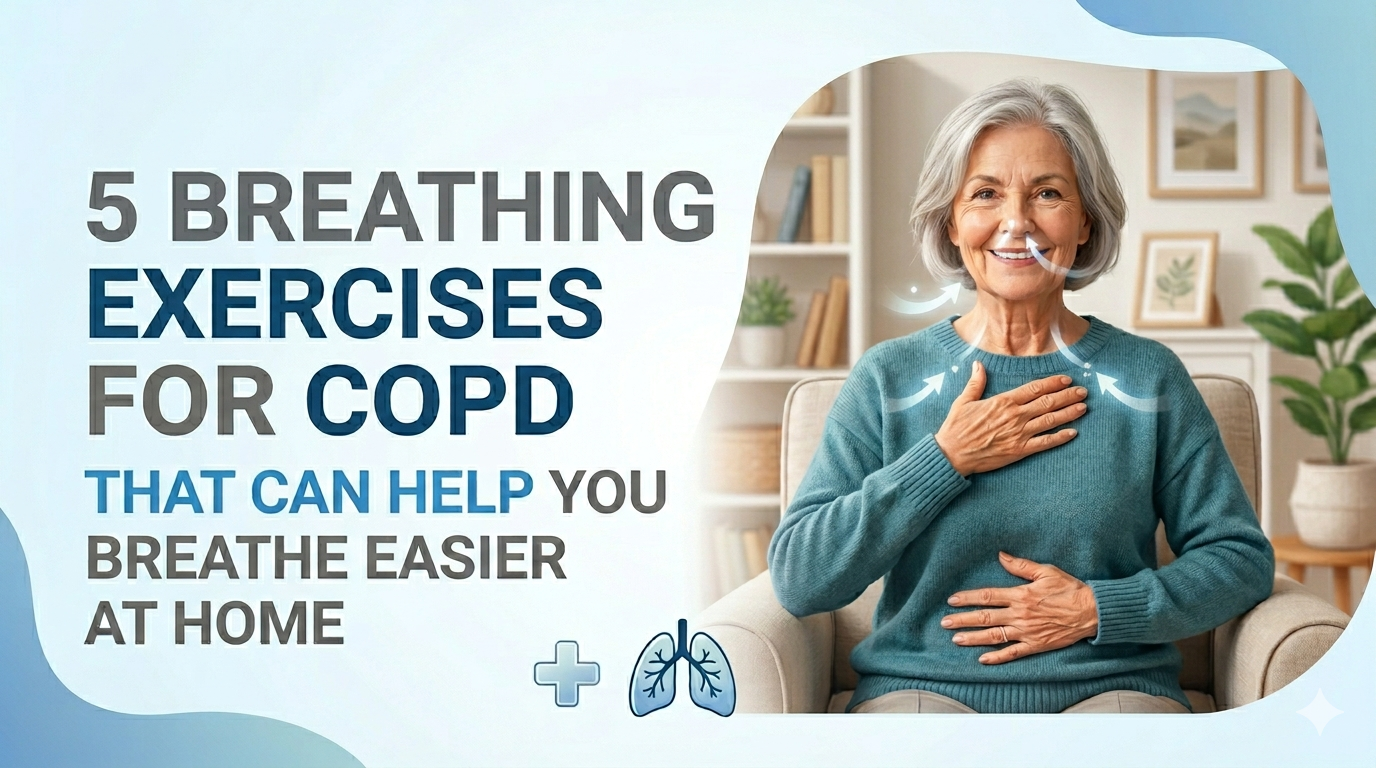
1. Pursed-lip breathing
Pursed-lip breathing is one of the most effective and immediately accessible techniques for COPD. It slows your breathing rate, keeps the airways open longer, and helps release trapped air from your lungs - a common issue in COPD.
How to do it:
Relax your neck and shoulder muscles.
Inhale slowly through your nose for a count of 2.
Pucker your lips as if you're about to whistle or blow out a candle.
Exhale slowly and gently through your pursed lips for a count of 4.
Repeat 5-10 times.
You can use this technique whenever you feel short of breath - during activity, when climbing stairs, or simply to slow a rapid breathing rate. Many people find it helpful to practise daily so it becomes second nature.
2. Diaphragmatic (belly) breathing
Most people with COPD tend to breathe shallowly using the muscles in their chest and neck. Diaphragmatic breathing retrains you to use your diaphragm - your most powerful breathing muscle - which leads to more efficient oxygen exchange and less fatigue.
How to do it:
Lie on your back with your knees slightly bent, or sit comfortably in a chair.
Place one hand on your chest and one on your belly, just below your ribcage.
Breathe in slowly through your nose. Your belly should rise and push against your hand. Your chest should remain relatively still.
Tighten your belly muscles as you exhale slowly through pursed lips. The hand on your belly should fall.
Practise for 5-10 minutes, two to three times per day.
This exercise may feel tiring at first if you're not used to using your diaphragm. Start with short sessions and build gradually.
3. Controlled coughing
A productive cough is your lungs' natural defence - it clears mucus that can obstruct your airways and make breathing harder. Uncontrolled coughing, however, can be exhausting and ineffective. Learning to cough in a controlled way helps clear your lungs more efficiently with less energy.
How to do it:
Sit upright in a chair with your feet flat on the floor.
Take a slow, deep breath through your nose.
Hold your breath for 2-3 seconds.
Using your stomach muscles, give two short, sharp coughs in quick succession - mouth open. The first loosens mucus; the second moves it.
Pause and breathe normally for 30 seconds before repeating.
This technique is particularly helpful in the morning when mucus tends to accumulate overnight, or after using an inhaler.
4. The 4-7-8 breathing technique
The 4-7-8 technique is a structured breathing pattern that activates your parasympathetic nervous system, slowing your heart rate and reducing anxiety - both common triggers for breathlessness in COPD. It's also an excellent technique to use before bed if you struggle with sleep.
How to do it:
Sit comfortably with your back straight.
Exhale fully through your mouth to begin.
Close your mouth and inhale quietly through your nose for a count of 4.
Hold your breath for a count of 7.
Exhale completely through your mouth for a count of 8, making a gentle whooshing sound.
This counts as one cycle. Repeat 3-4 times.
If holding your breath for 7 counts feels uncomfortable, shorten the ratio while maintaining the 1:1.75:2 proportion (e.g., 4-7-8 becomes 2-3.5-4).
5. Paced breathing during activity
One of the most practical breathing skills for daily life with COPD is learning to match your breathing to your movements. Paced breathing reduces the chance of becoming "air hungry" during activity and allows you to do more with less breathlessness.
How to do it during walking:
Exhale as you exert effort (e.g., when taking a step or lifting your foot).
Inhale during the easier phase (e.g., when your foot returns to the ground).
Try a 2:4 ratio - inhale for 2 steps, exhale for 4 steps.
Always breathe out on the hardest part of the activity.
You can apply the same principle when climbing stairs (exhale going up each step), bending down, or lifting objects. Over time, this becomes automatic.
Take it further with a structured pulmonary rehabilitation program
Breathing exercises are a powerful starting point. But the research is clear: patients who participate in a structured pulmonary rehabilitation program see significantly greater improvements in breathlessness, exercise capacity, quality of life, and hospital readmission rates.
iMaster Health's virtual pulmonary rehabilitation program brings together all of the above, and much more, in a clinician-designed program you can access entirely from home. No waitlists. No travel.
The program includes:
On-demand exercise library tailored for lung conditions
Live Zoom sessions with our clinical exercise physiologist
Guided breathing exercises and airway clearance techniques
Educational podcasts from respirologists and respiratory therapists
Lung-friendly nutrition recipes
Habit tracking, journaling, and community support
Members like Karen (70, pulmonary fibrosis) have seen their oxygen saturation and endurance improve. Tatijana (51, COPD and asthma) increased her lung capacity by 12% in one year. Rick (64, COPD) can now walk, climb stairs, and do light work without the breathlessness that once stopped him.
Ready to breathe better? Start with our free intake assessment - we will tailor your program to your condition and current abilities.